
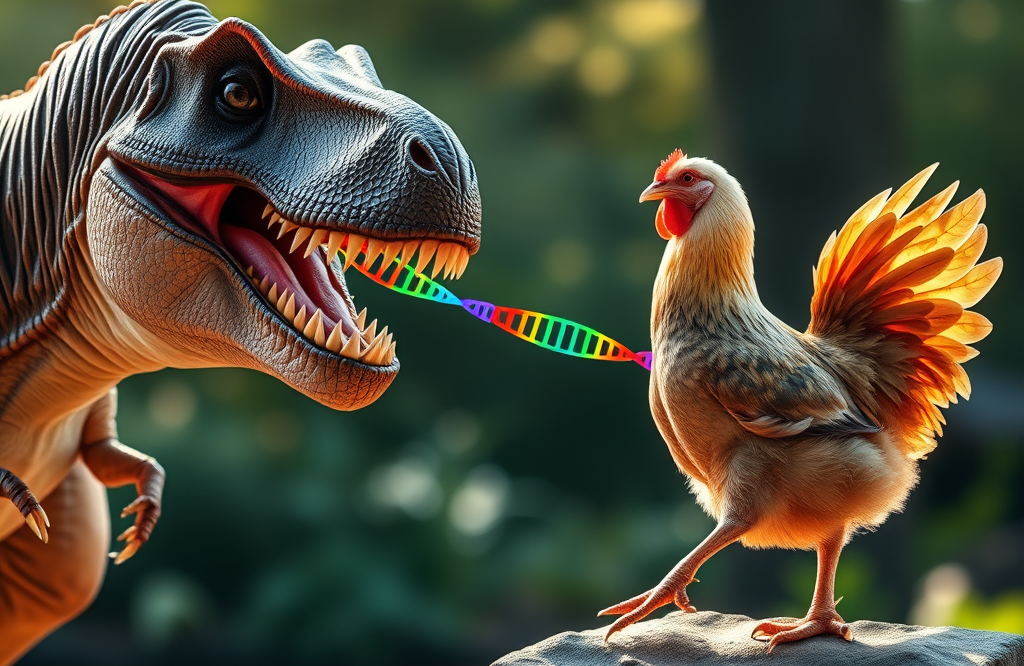
Imagine a world with towering predators. They had razor teeth and ruled the land. The mighty Tyrannosaurus rex struck fear into the hearts of every creature. Now, fast-forward 66 million years, and its closest living relative isn’t a monstrous reptile but… your backyard chicken.
Yes, science confirms it: chickens are the modern-day descendants of dinosaurs, with a direct evolutionary link to the infamous T. rex. How did a creature once known as the “tyrant lizard king” evolve into the humble, egg-laying bird we know today? Let’s crack open this evolutionary mystery.
The Dino-DNA Connection: More Than Just a Theory
The idea that birds evolved from dinosaurs isn’t new. It dates back to the 19th century when scientists noticed striking similarities. They observed these similarities between Archaeopteryx (a prehistoric bird-dinosaur) and modern birds. But the real breakthrough came with genetic and fossil evidence:
- Shared Anatomy: Chickens and T. rex both have wishbones (furcula), hollow bones, and similar hip structures.
- Molecular Evidence: A 2007 study found that collagen proteins in a T. rex fossil matched those in chickens more closely than any other living reptile.
- Theropod Family Tree: Both T. rex and chickens belong to the theropod group—bipedal, mostly carnivorous dinosaurs that eventually gave rise to birds.
So, the next time you see a chicken scratching the ground, think of it as a tiny T. rex hunting for its next meal.
From Scaly Predator to Feathered Farmbird
How did a ferocious apex predator shrink into a barnyard bird? Evolution worked its magic through:
A. The Feather Revolution
- Early theropods like Velociraptor had proto-feathers for insulation and display.
- Over millions of years, these evolved into flight feathers, leading to the first true birds.
B. The Shrinking Act
- Dinosaurs didn’t just “turn into” birds—many grew smaller over time due to ecological pressures.
- Smaller bodies meant faster movement, better heat regulation, and new survival strategies (like flying).
C. Survival of the Peck-est
- After the asteroid wiped out giant dinosaurs, small, adaptable, bird-like creatures survived.
- Chickens, like all birds, inherited traits that helped them thrive—lightweight bones, efficient lungs, and sharp instincts.
T-Rex Traits You Can Spot in Your Chicken
Believe it or not, your chicken still carries some dino-mite behaviors and features:
✅ The Famous “T-Rex Arms”
- T. rex had tiny arms compared to its body—chickens have similarly short wings relative to their size.
✅ Killer Instincts (Sort Of)
- Chickens may peck at bugs, small mice, or even each other—echoing their carnivorous ancestry.
✅ Egg-straordinary Reproduction
- Dinosaurs laid eggs, just like chickens. Some even brooded nests the way hens do today.
✅ That Iconic Walk
- Both T. rex and chickens walk on two strong legs with a distinctive strut.
Why This Matters: Dinosaurs Never Really Went Extinct
We often think of dinosaurs as ancient relics, but in reality:
- Birds are dinosaurs—the only lineage that survived mass extinction.
- Chickens, as one of the most common birds, are living proof of evolution in action.
- Studying chickens helps scientists understand dinosaur behavior, genetics, and development.
So, the next time you hear a rooster crow, remember: that’s not just a bird. It’s the last echo of the Jurassic era.
Conclusion: The Ultimate Evolutionary Glow-Up
Evolution has transformed the terrifying Tyrannosaurus rex into a domesticated chicken. It has taken one of Earth’s most fearsome predators and turned it into a barnyard staple. But deep down, every cluck, scratch, and peck is a living legacy of the dinosaur age.
So, the next time you enjoy fried chicken, just think: you’re basically eating dinosaur nuggets.
 Science Sansar