
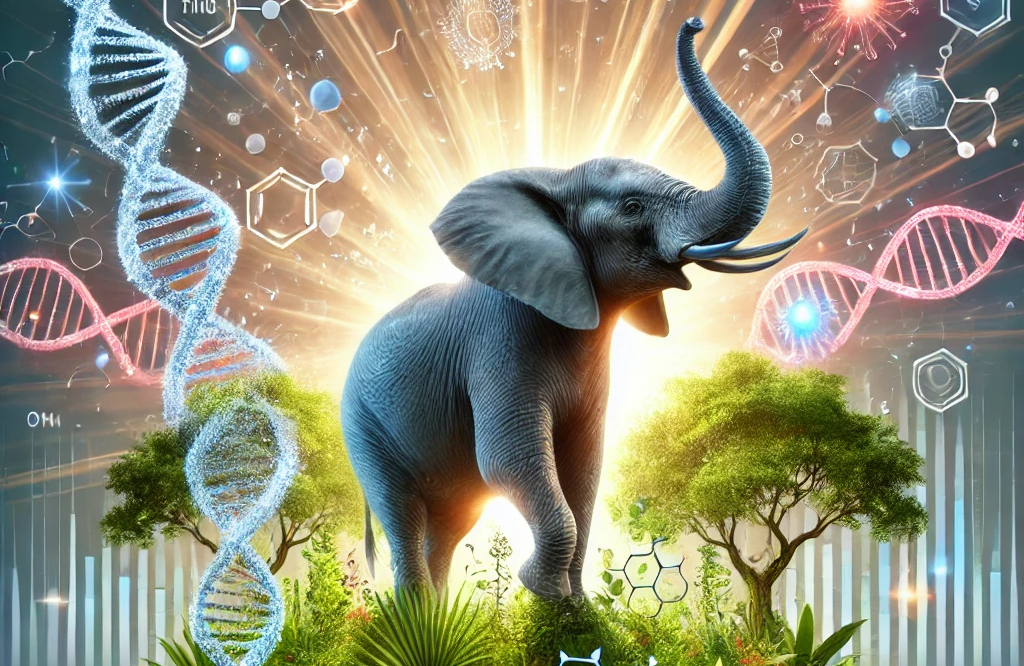
Cancer, a disease caused by the uncontrolled growth of abnormal cells, affects most animals, including humans. However, elephants—large mammals with lifespans similar to humans—are remarkably resistant to cancer. This phenomenon, often referred to as “Peto’s Paradox,” has fascinated scientists for decades. Although elephants have significantly more cells than humans, their cancer mortality rate is less than 5%. In contrast, it is about 20% in humans. Understanding why elephants rarely get cancer has opened up new avenues in cancer research and medicine.
Peto’s Paradox: The Puzzle Behind Cancer Rates
Peto’s Paradox describes that larger animals with longer lifespans do not have proportionally higher rates of cancer. These animals have more cells and cell divisions. In theory, the more cells an organism has, the greater the chances of mutations leading to cancer. Yet, elephants defy this expectation. Scientists have uncovered several unique biological adaptations in elephants that contribute to their cancer resistance.
The Genetic Secret: Extra Copies of TP53
A major breakthrough in understanding elephant cancer resistance is their extra copies of the TP53 gene. This gene is often called the “guardian of the genome.” Humans have only one pair of TP53 genes, while elephants have at least 20 copies. This gene plays a critical role in identifying and repairing damaged DNA or initiating cell death in irreparably damaged cells.
When a cell’s DNA is damaged, TP53 proteins activate a process called apoptosis. This is also known as programmed cell death. It prevents the damaged cell from turning cancerous. Elephants have 20 copies of the TP53 gene. They produce a much larger quantity of TP53 protein. This enables their bodies to detect and eliminate abnormal cells far more effectively than humans.
LIF6: The Zombie Gene That Protects Elephants
In addition to TP53, researchers have identified a reactivated gene in elephants called LIF6. Dubbed the “zombie gene,” LIF6 was previously nonfunctional in many mammals, but it has evolved a new purpose in elephants. When activated, LIF6 works in tandem with TP53 to kill damaged cells quickly, preventing them from becoming cancerous.
Studies show that the LIF6 gene encodes a protein. This protein directly attacks the mitochondria of damaged cells. It causes them to self-destruct. This mechanism adds another layer of protection to elephants’ already robust defense against cancer.
Efficient DNA Repair and Immune Surveillance
Elephants also exhibit enhanced DNA repair mechanisms, which further reduce the risk of mutations leading to cancer. Their cells have been shown to repair DNA damage more efficiently than human cells. Additionally, their immune systems are highly vigilant, rapidly identifying and eliminating abnormal cells.
Evolutionary Perspective: Why Elephants Developed Cancer Resistance
Elephants’ evolution as large, long-lived animals likely drove the development of these powerful anti-cancer mechanisms. As animals grow larger and live longer, the likelihood of accumulating mutations increases. Without robust defenses against cancer, elephants’ survival and reproduction would have been compromised. Over millions of years, natural selection favored individuals with enhanced DNA repair, apoptosis, and immune functions.
Implications for Human Cancer Research
The study of elephant genetics and cancer resistance has significant implications for human medicine. By understanding the mechanisms behind TP53 and LIF6, researchers aim to develop new therapies that mimic these natural defenses. For example, drugs that enhance TP53 activity or mimic LIF6’s mitochondrial targeting could revolutionize cancer treatment.
Additionally, elephant-inspired research may lead to preventive strategies, helping humans mitigate cancer risks before tumors develop. The idea highlights the importance of studying diverse species. By doing this, we can harness nature’s solutions to combat human diseases. This approach can help solve complex medical challenges.
Conclusion
Elephants’ remarkable ability to resist cancer is a testament to the ingenuity of evolution. These majestic creatures have extra TP53 genes. They also have reactivated zombie genes like LIF6 and robust DNA repair systems. Through these, they have developed a natural immunity to a disease that remains a leading cause of death in humans. Understanding and applying these insights could one day lead to breakthroughs in cancer prevention and treatment. The key to curing one of humanity’s deadliest diseases may lie in the wisdom of the animal kingdom.
Suggested by Tathagata Kundu.
 Science Sansar