
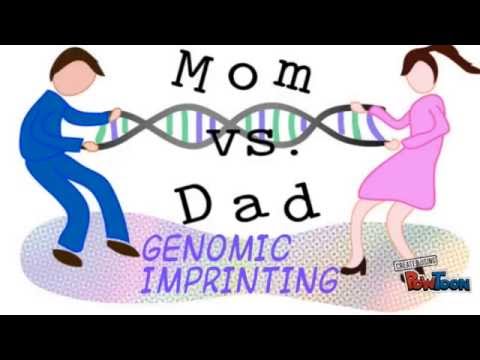
Genomic imprinting is a biological process for the reversible gene inactivation where a gene is biochemically marked with information about it’s parental origin.
Imprinting is achieved by the methylation (addition of -CH3 group) in both DNA ( on C residue of CpG sequence) and proteins ( on Lys amino acids of the histones). Basically, imprinting is a process of methylation of DNA or histones to suppress the respective expression in a parent-specific manner.
Why does it takes place?
Imprinting does not occur on every chromosomes. Only a small percentage (only nine chromosomes) of all human genes are known to have regions that undergo genomic imprinting. The reason is still unexposed why some genes are imprinted and others are not. Probably it may be for the development of the male or female specific organs during the embryo differentiation.
These epigenetic markers are imprinted in the germline of the parents and are maintained through mitosis in the somatic cells of an organism and also in germ cells in a sex specific manner.
When does it happen?
When zygote is formed, that is after fertilization, the each set of the diploid chromosomes are imprinted as they were in their respective donor cells (sperm and egg). During the embryo differentiation, the somatic cell lineages will have the chromosomes of exactly same imprinted pattern of that of the zygote but the story will be different in case of cells of germline lineages.
After the germline differentiation, the Primordial Germ Cells (PGCs) have no imprint on their chromosomes. The imprinting is lowest at that time. By the time when the germline is established the imprinting takes place in a sex-specific manner, that is; if eggs are produced, all chromosomes will have imprints of that of mother or if sperms are produced, all chromosomes will have imprints of that of father.
Disorders related to genomic imprinting:
- Prader-Willi syndrome- Caused due to the SNRPN gene on chromosome 15. The SNRPN gene is a paternally expressed and maternally imprinted gene. So if paternal counterpart of this is missed or if the two maternal counterparts are incorporated, the expression of that particular gene will be shuted down and the disease will take place.
- Angelman syndrome- Caused due to the UBE3A gene on chr. no 15. The UBE3A gene is maternally expressed and paternally imprinted gene. So if the maternal counterpart of this gene is missed or if the two paternal counterparts are incorporated, the expression of that particular gene will be shuted down.
- Beckwith-Wiedemann syndrome- Caused due to Igf2 gene, a maternally imprinted gene. DNA mutation or epimutation activates maternal Igf2, resulting in two copies of the gene.
 Science Sansar