
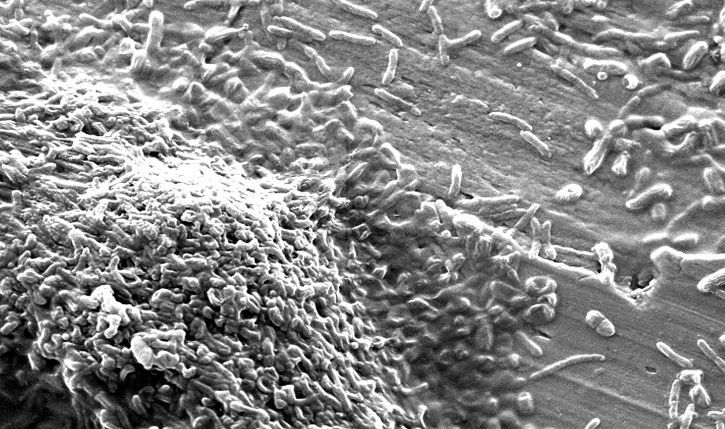
The way microorganisms create their own microenvironment and niches is by forming Biofilm, a lifestyle exhibited by microorganisms. It is a highly structured community of microorganisms (bacteria) that protect them from environmental hazards.
What is biofilm actually?
A biofilm is any group of microorganisms in which cells stick to each other on a living or non-living surface. These adherent cells are frequently embedded within a self-produced matrix of extracellular polymeric substance (EPS), which is generally composed of DNA, proteins and polysaccharides, releasing by themselves. The DNA can be taken up by the members of the community. Thus, the genes can be transferred from one cell to another.
Depending on environmental condition, biofilms can become so large that they are visible and macroscopic dimensions. These thick biofilms are called microbial mat. These mats are so thick that visible light can only penetrate approximately 1 mm into these communities.
Biofilm protects the microorganisms from UV radiation, antibiotics and many anti-microbial agents by activating the synthesis of numerous genes so as proteins, which is only possible within the biofilm, not by the individual microorganism.
How the community (biofilm) is formed?
To form a biofilm, for a microbe, it is a community effort. The formation of biofilm can be discussed under 5 sub-headings:
Initial attachment:
It begins with the attachment of free-floating bacteria to a surface. When the bacteria come near to the surface, they experience the Van der Waal force which helps them to make physical contact with the surface by pili, flagella and other adhesion structures. Those, who are unable to attach directly to the surface, anchor themselves to the earlier one.
Hydrophobicity also plays an important role in determining the ability to form a biofilm, as the bacteria with greater hydrophobicity reduce the repulsion between the surface and themselves.
Irreversible attachment:
The attached cells produce an extracellular matrix with their own DNA, proteins and exopolysaccharides, resulting a microcolony.
Maturation I & II:
In these two stages, the microcolony converts itself into an adult colony, by increasing its mass through cell division and addition.
Dispersion:
Dispersal of the cells from the colony is an essential step. It enables the bacteria to form a new colony. It occurs when the extracellular matrix is degraded and allows the release of the planktonic bacteria. The degradation of the matrix is brought about by several enzymes like dispersion B, deoxyribonuclease and by a fatty acid messenger (cis-2-decenoic acid).
What make the biofilm interesting?
Biofilms are usually found on solid surfaces immersed in or exposed to an aqueous environment, although they can form floating mats on liquid surfaces. Biofilms are considered to be the product of evolution and it had to gain some unique characteristics to survive in adverse conditions.
Quorum sensing:
The phenomenon, by which a bacterium performs the community behaviour, is called quorum sensing. It is a system of stimuli and response that is related to the population density. Quorum sensing can occur within a single species as well as between diverse species. A variety of different molecules can be used as signals. For Gram-positive bacteria these are oligopeptides and for Gram-negative bacteria, these are N-acyl homoserine lactones (AHL). A family of autoinducers, known as autoinducer-2 (AI-2) is used by both Gram (+) ve & (-) ve bacteria.
For example, in Gram (-) ve bacteria, AHL is freely diffusible across the plasma membrane. When the population increases, the density of the AHL, that diffuses out of the cell, also increase. As a result, the density gradient is reversed and AHL enters the cell. When AHL reaches a threshold level inside the cell, it induces the expression of some target genes that control a number of functions depending on the microbes. For example, in Vibrio, the AHL activates the enzyme luciferase to initiate emission of light.
Because the influx of AHL in the cell is density dependent, it helps individual cells to access the population density.Thus, quorum sensing serves a major role in cell to cell communication within a biofilm.
Susceptible to antimicrobial agents:
Free-floating cells neutralize the microbial agents. But the capacity of a lone cell is insufficient to draw down the antimicrobial concentration. In contrast, the collection of neutralizing power of the cells of the biofilm community leads to slow or less penetration of the antimicrobial agents in the biofilm.
For example, Salmonella typhimurium can form biofilm with defence power against host’s immune cells.
Biofilm differs in genetic expression compared to the planktonic bacteria:
The genetic expressions of planktonic bacteria of a species differ largely when the individuals of the same species form a biofilm.
We can get a clear view of cellular activity by examining the protein produced by cells at a particular time a technique called SDS-PAGE (Sodium Dodecyl Sulphate-PolyAcrylamide Gel Electrophoresis). In this technique, the larger proteins can be visualized in the top and the small proteins in the bottom of the gel as a dark band.
Biofilm: Beneficial Or Detrimental?
It is very important to point out that biofilms are an integral part of the natural environment and can also serve very beneficial purposes, such as in the treatment of drinking water, wastewater and detoxification of hazardous waste.
Both the beneficial and detrimental aspects of biofilms are summarized below:
Beneficial impacts-
1. Wastewater treatment:
Biofilms can be used in treating wastewater. In this treatment, the bacteria grow and make biofilm on the surface of the media and become adapted to use the organic matter of that water. Over the time, the biological filtration leads to the conversion of organic carbon of water into the bacterial biomass. After that, the biofilm is removed by backwash cycle. This biologically treated water has lower disinfectant than conventionally treated water if the water is rich in organic carbon.
2. Remediation of contaminated soil:
Depending upon the soil condition, biofilm density varies greatly ranging from patchy discontinuous colonies to thick dense colonies. When any toxic substances like fuel oil, pesticides etc. are accidentally released in the ground, the soil bacteria use these contaminants as a food source to adjust their ecological composition.
3. Microbial leaching:
Microbial leaching is the process of extracting metals from ores with the use of microorganisms. This method is used to recover many different precious metals like copper, lead, gold etc. In this process, acidified water (pH 1.5-3.0) is sprayed over the ore. Acidophilic bacteria (e.g.- Thiobacillus ferrooxidans) oxidise the soluble ferrous ion and attack the sulphide minerals, releasing the soluble cupric ion that can then be recovered from aqueous solution.
Detrimental impacts-
Biofilm can be very harmful. It is known that bacteria in biofilm mode are up to 1000 fold resistant to antibiotics than their counterparts. The harmful effects caused by the biofilms are:
Clinical effect:
Biofilms are linked to several hospital acquired infections. These infections are the result of the interface between the soft, moist tissues of the patients and the solid surface of the medical devices. Biofilms also attack and hamper different surgical devices like mechanical heart valves, hip replacement, catheters etc.
Public health:
Biofilms play a vital role to create disease in human –
- Otitis media: a most common acute ear infection in children in U.S.
- Bacterial endocarditis: infection in the inner surface of the heart and its valves.
- Cystic fibrosis: a chronic disorder resulting in increased susceptibility to serious lung infection.
- Legionnaire’s disease: an acute respiratory infection resulting from the aspiration clumps of Legionella biofilms.
REFERENCES:
- Biofilmbook.hypertextbookshop.com
- “Resonance”. Resonance 19.9 (2014): 878-878. Web.
- Willey, Joanne M et al. Prescott, Harley, And Klein’s Microbiology. New York: McGraw-Hill Higher Education, 2008. Print.
 Science Sansar